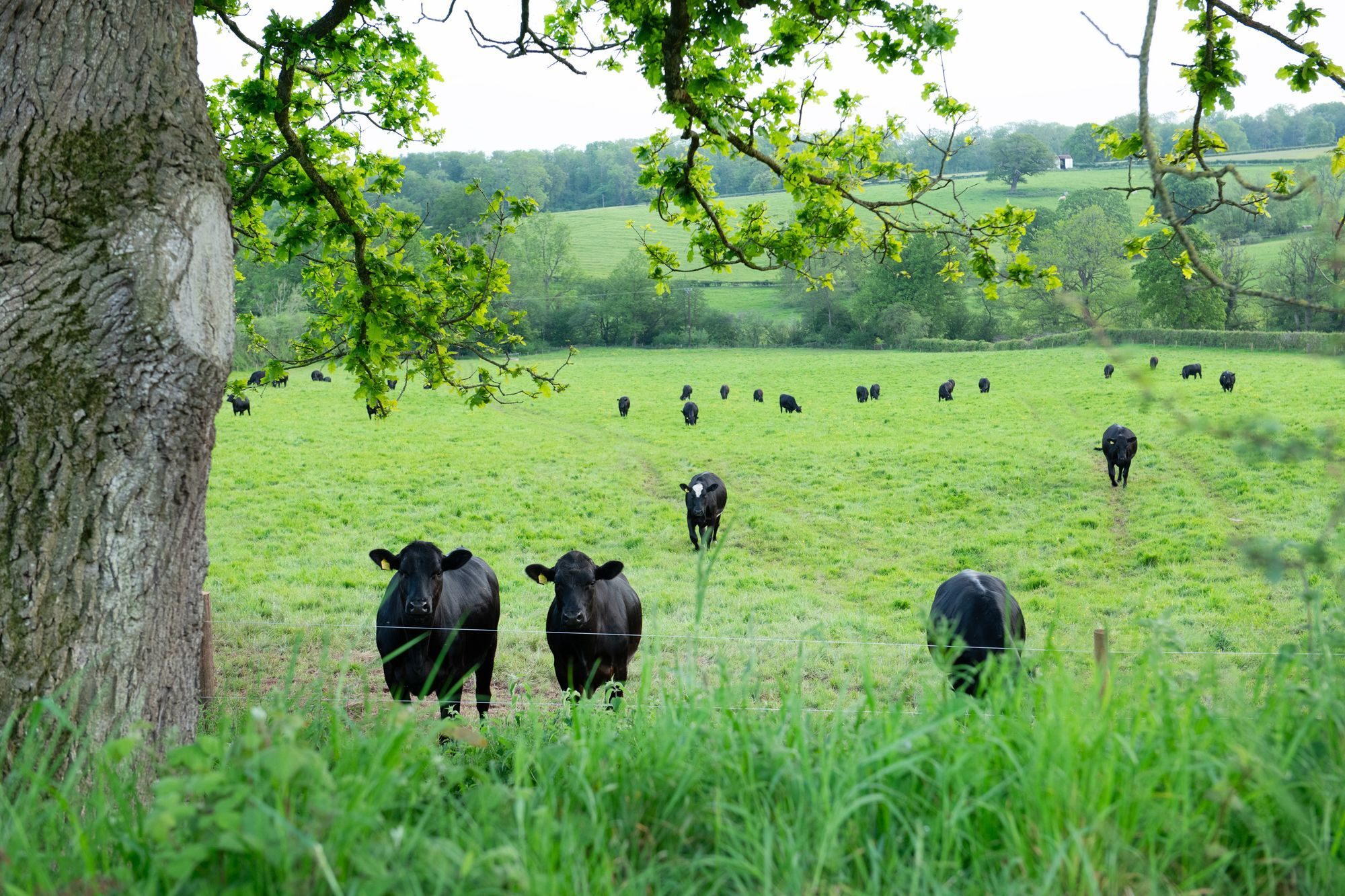
Lower Wood Farmhouse stands at the end of a half-mile drive in south Shropshire, eight minutes from Ludlow. Four acres belong to the house. The ground beyond the fence, some four and a half thousand acres of the Downton Hall Estate, is a working cattle farm, and Sam farms it.
A working farm holiday in the UK often means a converted barn with a view of a field that somebody else tends. This is the other version. The land here runs to a calendar set by grass growth and weather rather than by check-in days, and a party staying between June and September watches the busiest half of the farming year happen from the terrace.
The ground, and what is on it
The estate carries cattle and sheep. Around two hundred head graze the fields within sight of the house, moving between paddocks through the summer as the grass is eaten down and rested. Clee Hill closes the eastern horizon. Between the house and the hill there is grass, hedge, oak and very little else. The nearest building is the gatehouse at the top of the drive.
The practical consequence for a stay is that the view changes week to week. A field that was waist-high on Monday is cut flat by Wednesday and green again a fortnight later. Cattle appear in a paddock overnight and are gone by the weekend. This is the part that guests with children tend to report back on, ahead of the castle and ahead of the hot tub.
Who Sam is
Sam runs the farm. He cuts the fields, moves the cattle and keeps the ground in order across the year. He is not staff at the house and he does not run tours, which is the reason a conversation with him is worth having. Anyone who catches him at a gate gets the actual answer to why a field is being cut this week rather than next, which is usually a forecast rather than a plan.
Farming conversation is best had in the gap between jobs. Early morning before the dew lifts, or the half hour at the end of an afternoon when a machine is being refuelled. Mid-cut is not the moment.
For those who would rather have it arranged than left to chance, a morning with the farm is one of the additions listed on the experiences page. It is worth requesting at the point of booking rather than on arrival, because what it involves depends entirely on the week’s work.
June: the first cut
The first cut of silage is the opening move of the farming summer and it happens on a few hours’ notice. Grass is mown, left in rows to wilt for a day or two, then gathered and either wrapped into bales or carted to a clamp and rolled down under sheeting. The sequence for one field takes about three days if the weather holds. The weather is the only thing that matters. Rain in the middle of it costs feed quality for the whole of the following winter, which is why a settled forecast empties the yard of everybody at once.
June is the month of machinery. Mowers in the morning, a tedder spreading the rows out to dry, a rake pulling them back into lines, then the forager or the baler behind. The smell of cut grass sits over the whole valley for a week. Children who like tractors will not need entertaining that week, and the terrace is the grandstand.
July: the long days
July runs later than any other month on the farm. Light lasts until close to ten and the work uses all of it. Second cut silage comes off the fields that were mown in June and have grown back. Hay is made where the ground suits it, which needs a longer settled spell than silage does and so gets attempted less often.
Cattle are checked daily and moved through the grazing. Troughs are watched in a dry spell. Fences are walked. None of this is dramatic and all of it is visible from the drive.
July is also when the farm is loudest late in the evening. The honest note for anyone booking a July week is that a tractor may still be working a field at nine at night in the middle of a settled run. Guests who came for a working farm count this as the point of the place. Anyone expecting silence after seven should know it in advance.
August: the quiet middle
August is the least mechanical month of the summer. The cuts are in, the grazing is established, and the work turns to maintenance and to watching. The hedges cannot be touched at all: cutting or trimming hedgerows on agricultural land in England is prohibited from 1 March to 31 August under the Management of Hedgerows (England) Regulations 2024, which protects nesting birds across the whole breeding season. The hedges around the house are therefore at their fullest and untidiest in August, which is exactly what they should be.
This makes August the best month for walking the land without getting in the way of it. The pond, the oaks and the hedgerows are at their most productive for anyone interested in what lives in them. Blackberries come in along the drive from the middle of the month and hold into September.
September: the turn
September is when the year changes direction. Hedge cutting becomes legal again on the first of the month and the flails start almost immediately, which is why the lanes around Ludlow look suddenly trimmed in the second week of September. Cattle come down off the higher ground as the nights cool. The hens on the yard keep laying and the yard itself goes quiet.
Ludlow turns in the same month. The food festival takes over the castle for a weekend in September and the town fills for three days. The plan for that weekend is set out in the festival playbook.
The first shoot drives on the estate follow in October. September is the month of preparation for them rather than the month of them, which means dogs and keepers about the place and a general tidying of the ground.
What guests actually see
The reliable sightings, in rough order of how often they get mentioned afterwards: cattle in the field beyond the fence, most days. Tractors working within earshot, most days through June and July. Hens on the yard, always. Buzzards over the fields, most afternoons. Deer at the field edges early and late.
Three things help. Boots that can take mud in any month, because a cut field is not a lawn and a wet August is a real possibility. A pair of binoculars, which the house does not supply. And the habit of standing still at a gate rather than walking up to a fence, which is the difference between watching cattle and moving them.
What guests do not see is most of it. The stock check happens before six. A field is walked and assessed days before anything visible occurs on it. The decision to cut is made looking at a phone in a yard, and by the time the machinery arrives the interesting part is over. A working farm reveals about a tenth of itself to anyone watching from a terrace, which is the argument for asking rather than assuming.
The farm gates are working gates. Leaving them as found is the one rule that matters.
When to come
For machinery and the visible drama of the year, June and the first half of July. For warmth, long evenings and a farm calm enough to walk through without interrupting it, August. For the turn of the season, the food festival and the first cold mornings, September.
The house behind all of it has five bedrooms and sleeps twelve, which is what makes a farm week work for two or three families at once rather than one. The room-by-room case for that is in Twelve at the farmhouse. Dates and rates sit on the booking page.
The farm works through every week of the summer regardless of who is staying in the house. The fields are cut between June and September, the cattle move through the grazing across the same months, and the hedges are left alone until the first of September.
Lower Wood Farmhouse is a five-bedroom farmhouse on the 4,500-acre Downton Hall Estate in south Shropshire, eight minutes from Ludlow. It sleeps twelve across one super king, three doubles, a bunk room and a sofa bed, with three bathrooms and two further WCs. Book direct.